
Category: Latest Thinking

Evolving Risks in Continuous Drug Manufacturing

BY DANIEL BRETTLER

Exploring How the Continuous Manufacturing of Pharmaceutical Drugs Introduces New Challenges when Securing Insurance Coverage and Mitigating Risks

The adoption of continuous manufacturing systems has the potential to transform pharmaceutical drug production by increasing operational capacity and reducing exposure to many traditional vulnerabilities. But the transition from batch to continuous processes not only marks a shift in operations, it also introduces a fundamental shift in risk that must be addressed in a drug maker’s risk management analysis and insurance programs, if applicable.

Continuous manufacturing is nothing new to oil refineries, natural gas processing plants and other manufacturers. These processes have led to improved efficiencies, greater processing speed, boosted quality, less manpower and increased safety when compared to batch-production systems. It can enable manufacturers to more nimbly respond to changes in customer demand and more easily scale their businesses.

While the life science industry has been slower to adopt it, continuous manufacturing has the potential to revolutionize how life-saving medicines are developed and delivered. Some pharmaceutical companies have already implemented continuous processes for regular chemical drugs, and it’s likely the manufacture of biologics will be transformed by continuous processes in the next several years.

This industry wide shift is also strongly supported by the FDA, which is pushing for a future of reduced regulatory uncertainties and more consistent quality control. The administration has stated that cost savings experienced by pharmaceutical companies could be passed on to the customer by way of lower drug prices. In fact, the FDA recently awarded three grants worth nearly $6 million in total to universities and nonprofits to study and promote the adoption of continuous manufacturing of drugs and biological products.

“Continuous manufacturing utilizes technologies that offer clear benefits for both patients and industry,” FDA Commissioner Scott Gottlieb said in an August 2018 statement. “The approach has the potential to shorten production times and improve the efficiency of manufacturing processes. These benefits translate to lower cost of production and thus the cost of medicine.”

Through the lens of risk management, continuous manufacturing represents a fundamental shift. Traditional exposures associated with human error would be significantly reduced and attention would shift to risks associated with the breakdown of processes. As such, many insurance companies are still determining how to underwrite policies in this space.

In order to secure fair and accurate pricing, drug producers must reduce the uncertainty around continuous manufacturing. They must fully understand and clearly convey how continuous manufacturing is reducing their risks in certain areas while opening up new liabilities in others. In this light, there are several shifts drug manufacturers must consider when contemplating making the switch.

SHIFT IN RESOURCES

Continuous manufacturing operations rely heavily on automated machinery and processes that keep the system moving while simultaneously monitoring for quality and specifications in real time. As a result, human intervention is largely removed from the equation. This allows production to continue 24 hours a day and also eliminates human error and the cost associated with employing these workers. Continuous manufacturing equipment also only takes up a fraction of the space of batch-based facilities, thereby reducing the need for giant production facility footprints.

In total, this significantly reduces operating costs. A 2015 Wall Street Journal article estimated that the time and cost savings gleaned from continuous manufacturing processes could save drug producers up to 30 percent in annual operating costs.

While operating costs are significantly lower in a continuous manufacturing system, FM Global Chemical and Pharmaceutical Principal Engineer Pat Mahan told me in an interview the machinery and equipment involved is much more valuable. Repairing and maintaining such complex equipment can be much more expensive, time-intensive and labor intensive than fixing the machines used in batch manufacturing. These machines are often custom built or tailored for the production of a specific product, he said.

“The equipment used in continuous manufacturing is so complex and unique that even a small break can lead to significant bottlenecks in the production process and longer-than-expected business interruptions,” Mahan said.

If drug producers are using a truly unique piece of machinery, the risk of these potentially significant business interruptions must be accounted for in their physical property and business interruption coverage. From a risk management perspective, Mahan says it’s crucial for manufacturers to “understand where they are introducing these critical potential bottlenecks” and address these liabilities in their risk management strategies in batch manufacturing. These machines are often custom built or tailored for the production of a specific product, he said.

SHIFT IN OVERSIGHT

Perhaps the greatest promise of continuous manufacturing is that quality assurance can occur without interrupting production. Operators can monitor and make adjustments to processes online, without any physical interference on the production line.

For example, in a traditional batch process, a stuck valve could cause a variation in the control conditions, slightly adjusting the temperature of a product. That variation would likely go undetected until the next sample was pulled, at which time the operator would determine how much of the batch was affected and if the variation warranted product disposal.

With continuous processes in place, technology can be continuously monitored and even self-correct any deviations from the control conditions. The risk of a temperature variation would be significantly mitigated, and companies would see far less “out of spec” product. Because continuous processes rely on single-use materials, the risk of product contamination at the manufacturing site is also significantly reduced.

As algorithms become increasingly sophisticated, pharma manufacturers will have the data and devices to prevent production failures. In the future, it may even be possible to leverage machine learning and predictive analytics to conduct preventative maintenance without shutting down the continuous process.

However, these network-connected sensors and monitoring devices create new areas of cyber liability by opening up entry points for cybercriminals to launch an attack.

Once inside the network, hackers can gain control of production equipment and make changes to the process that could lead to a litany of costly consequences. These sophisticated attacks have the potential to go undetected for days at a time, leading to enormous amounts of unusable product.

“If cyber security isn’t appropriately addressed, consequences could include bad product, business interruption, worker injury, and property loss such as fire, explosion or machinery breakdown events,” Aaron Kalisher, Executive Risk Engineering Specialist, Risk Engineering Services at Chubb NA told me in an interview.

These risks must be reflected in physical cyber insurance coverage Kalisher said, adding that there is ample appetite from insurance carriers to take on these risks. Kalisher noted that a comprehensive cyber insurance policy addresses these risks and provides measures and services to help mitigate cyber risk. However, determining the level of coverage and coming to terms on pricing can be difficult given the evolving nature of these liabilities and the potential severity of loss should a drug manufacturer suffer a cyber attack. It is imperative for drug producers to learn the intricacies of these policies as well as their own risks to ensure their risk needs are adequately addressed through a comprehensive cyber insurance policy.

SHIFT IN REGULATORY FOOTING

The switch from batch to continuous production of pharmaceutical drugs is not only a massive change for manufacturers; it’s a big change for regulators as well. While the FDA has been widely supportive of the transition so far, it will take time for regulators to adjust their guidance, approvals, and oversight of this new means of production.

For instance, Frank Goudsmit, CPCU, Senior Vice President, Life Sciences Industry Practice at Chubb NA told me in an interview that the speed in which regulators are able to validate manufacturing lines may slow given the complexity and automation of continuous manufacturing operations. Initially, regulators’ lack of familiarity with these facilities and the high-tech equipment involved will likely present some roadblocks to getting these production lines moving in the near future, he said. Also, when the equipment breaks down, the revalidation process will also require more time on behalf of regulators as they continue to familiarize themselves with new processes.

Looking further out, Goudsmit said continuous manufacturing will present new challenges for faulty product entering the stream of commerce and subsequent recalls. In theory, continuous manufacturing facilities contain state-of-the-art sensor technology that should catch an excursion that is trending out of specifications. This real-time control would minimize the frequency of product recalls. But when these sensors fail to recognize and self-correct an issue, does the severity of the impact increase? Cyber-related events can also impede the integrity of the manufacturing process when an out-of-specification condition is not properly recognized.

A NEW FRONTIER

The adoption of continuous manufacturing will certainly mitigate some of the traditional production risks surrounding oversight and deployment of resources. It has the potential to significantly cut operating costs and revolutionize the way drugs are produced for the better. But any shift in processes this large innately introduces new areas of liability. Making a switch to continuous manufacturing necessitates a ground up review of these risk exposures and pharmaceutical manufacturers must take proactive steps to address them.

Vulnerable network-connected devices, expensive and highly customized equipment, and new regulatory setbacks redefine risks such as potential physical equipment breakdowns, cyber security events, business interruptions, and potentially lengthy and costly product recalls. Fully understanding these risks, where they come from, and how to address them must be considered by manufacturers, risk managers, and underwriters.

Considering the novelty of this technology in the pharmaceutical space, many insurance carriers are still discovering how to properly price and underwrite these continually evolving risks.

Pharmaceutical manufacturers looking to implement continuous processes should engage knowledgeable insurance brokers who truly understand the benefits of this approach and how those should be reflected in pricing.

These professionals can work with manufacturers to explain to insurers how risks are transferring from certain areas to others and how that will need to influence the insurer’s response.

It is only a matter of time before continuous manufacturing takes hold of the pharmaceutical industry. Manufacturers are wise to begin looking at these processes and identifying the risks associated with them today to ensure they are prepared when the time inevitably comes to make a change.

For more information on how the adoption of continuous manufacturing will impact insurance coverage and risk management in the pharmaceutical industry or any questions on the services we provide the life sciences companies, call us at 1 (877) 861-3220.


For a print-friendly version, click here.

Preparing for the Worst of Workplace Violence: Active Shooter & Active Assailant

Insuring Construction Projects – Beyond General Liability

BY PHILIP GLICK

New construction and renovation projects can result in a broad range of potential professional liability insurance claims exposures for both the project owner or developer and the contractor and design professionals involved on a project. Unfortunately, many firms underestimate the need for coverage and over-estimate the extent that needed coverage may be available under a contractor’s commercial general liability policy.

This article will identify the limitations in professional liability coverage that may be available and present optional ways to obtain the professional liability insurance coverage needed.

WHAT ARE THE EXPOSURES?

Professional liability claims can arise from a broad range of construction related services:

  • The general contractor or construction manager, whether at risk or simply as an agent for an owner
  • Project architects and engineers
  • Environmental consultants
  • Zoning and land use consultants
  • Acoustic consultants
  • Interior designers
  • Curtain wall designers
  • Financing and investment related service providers
  • Leasing and property management firms
  • And many others

The underlying risks arise out of the provision of professional advice or consultation, as opposed to actual construction-related services.

WHAT COVERAGE IS AVAILABLE UNDER A COMMERCIAL GENERAL LIABILITY POLICY?

The standard unendorsed commercial general liability policy provided by the Insurance Services Office (ISO), the CG 00 01 04 13, does not contain a professional liability exclusion. However, almost every insurer that covers contractors will add a professional liability exclusion to a contractor’s policy. Most will include a broad exclusion of engineers, architects and surveyors exposures. Under this CG 22 43 04 13 Endorsement coverage is excluded for any claims involving bodily injury, property damage, or personal and advertising injury, arising out of the rendering of or failure to render any professional services by the insured contractor or any engineer, architect or surveyor who is either employed by the insured contractor or performing work on his behalf.

Worse yet, the definition of excluded “professional services” is very broad, including:

  • The preparing, approving or failing to approve, maps, shop drawing, opinions, reports, surveys, field orders, change orders or drawings and specifications
  • Supervisory, inspection, architectural or engineering services

As such this exclusion endorsement will eliminate coverage for claims arising out of a broad range of the everyday services provided by any contractor, including the selection and oversight of any architects or engineers.

Fortunately, there is a much more limited version of this exclusion, the ISO CG 22 79 04 13 Endorsement. This exclusion narrows the definition of excluded professional services, so that they do not exclude coverage for claims from “services within construction means, methods, techniques, sequences and procedures  employed  by you in connection with your operations in your capacity  as a construction contractor.” This give back of coverage will also extend to the preparing and approving of maps, shop drawings, opinions, surveys, etc. provided they fall under the exception described above.

Although the professional liability coverage provided under this better endorsement is significantly better, it still leaves important gaps in coverage.

The coverage provided is still limited only to professional liability claims due to “bodily injury or property damage” claims.

Accordingly, there is no coverage for claims involving pure economic loss. No coverage is provided for claims involving money-loss due to delays in completion, cost overruns, poor workmanship, work that does not meet the intended use for the project, usable square footage or layouts, etc.

WHAT IS THE COVERAGE SOLUTION?

The best solution for every contractor is to purchase a contractor’s or construction manager’s professional liability policy. This is typically done on a so-called “practice policy” where coverage is provided for all the contractor’s jobs during the 12-month insurance policy period. Oftentimes, this professional liability coverage can be combined with a contractor’s pollution liability coverage, either subject to an overall combined limit of coverage or preferably a separate limit for each coverage part.

Many contractor’s professional liability policies only cover claims for loss arising out of construction management consulting services performed by the contractor as an agent for an owner. The best policy forms will cover both of these services and those performed as a general contractor or construction manager at risk.

Under this typical coverage approach, the limits of protection are shared over all the jobs done by the contractor over the year. Some insurers will extend the coverage to provide a per-project limit on a job or to endorse an additional excess limit that would cover a particular job if the annual policy limit is eroded or used up from other claims.

Another option is to buy a standalone contractor’s professional liability policy for each job from the contractor’s existing insurer or another professional liability insurer.

It is also important that the owner and general contractor require and then verify that the project architect, engineer(s) and other project professionals all carry broad professional liability coverage with reasonable limits of liability. In some limited cases, the owner and contractor may be able to be covered as an additional insured on these consultant’s professional liability policies.

WHAT COVERAGE LIMITATIONS MAY APPLY?

In all cases, contractor’s professional liability policies are written on a claims made basis. This means there is only coverage for wrongful acts committed by the insured contractor after an agreed starting or prior acts date (usually the first date that a professional liability policy was purchased) and where the actual claim or lawsuit is filed during the current professional liability policy.

Because this coverage is written on a claims-made basis, it is critical that coverage be maintained on a continuous basis, or that an extended tail period be purchased to continue protection for claims that may be brought in the future after project completion.

The best contractor’s professional liability policies will also cover claims arising out of both potential bodily injury and property damage liability claims and claims alleging pure economic loss. Unfortunately, many policies still restrict their coverage to only bodily injury or property damage liability losses.

Unlike commercial general liability insurance, there is no standard contractor’s professional liability policy form available. Accordingly, it is critical that broad coverage be negotiated, including coverage for claims alleging cost overruns, delays in completion, and even breach of contract, provided the underlying claim also alleges that a loss is due to the contractor’s negligence.

In addition to purchasing coverage for the contractor itself, many project owners or developers will request that they be added as an additional insured on the contractor’s policy. Although this is typically available on a project-specific policy, many professional liability insurers are unwilling to do so under a more typical annual practice policy. If the owner can be added, it is important to be sure there is no exclusion on the contractor’s policy that eliminates coverage for a claim by one insured against another insured under the policy.

CAN THE OWNER PURCHASE HIS OWN COVERAGE?

Over the last several years the professional liability insurance marketplace has developed an innovative new form of coverage.

The project owner can purchase its own stand-alone policy for a given construction project known as an owner’s protective professional indemnity policy (OPPI). This is intended to cover any claims not covered by the contractor’s professional liability policy, as well as practice policies maintained by the project architect, engineer(s) and other project consultants. Like the professional liability policies carried by these other professionals, this OPPI coverage is written on a claim made basis and applies excess of any coverage available from other firms.

In addition to coverage in excess of the coverage available under these outside firm’s professional liability policies, some OPPI policies also provide coverage for possible professional liability losses the owner may incur by allowing them to file coverage for a claim directly under their own professional liability policy.

Given the broad range of potential exposures to loss that may not be covered by a contractor’s commercial general liability policy, it is important that every contractor consider purchasing a stand-alone professional liability policy.

In addition, every contractor should also look towards the architects, engineers and other consultants it works with to be sure they also maintain appropriate limits and scope of professional liability coverage to cover any claims arising out of their professional services.

Click here for printable download.

The Greatest Threat to R&D Companies – A Loss in the Lab

BY DANIEL BRETTLER AND KENNETH R. PIÑA, RPH, JD

Business Continuity Planning for Life Sciences Companies

Research and development projects consume vast resources—human and capital—and bumps in the road can greatly impact revenue, operating expenses, results, liability and property. Whether your business is creating a medical device or discovering a new vaccine, it’s your research lab that offers the greatest potential and greatest threat.

And if unprepared, a loss in the lab can be catastrophic. Yet, in spite of these threats, few companies are prepared for these risks and haven’t contemplated the insurance ramifications. We see time and again that the same companies that spend countless hours pouring over data, often fail to even scratch the surface of their projects from a risk management perspective.

Not all risk is created equal. Just ask a scientist. An early loss or interruption of an R&D project can cause a minor setback or a major, negative financial impact. It depends on many variables. Not only does a loss interrupt the project, but the trickledown effect can cause subsequent projects to be stalled or, worse, canceled, leaving researchers with unproductive time, costly materials unused, and deadlines missed. Additionally, a loss could impact a company’s future revenue stream.

It’s not all bad news: Many potential losses can be avoided entirely or effectively mitigated if properly identified and addressed. And, some losses are insurable.

We recommend the following three steps:
1. Assess & Manage Risk
2. Quantify the Potential for Loss
3. Be Able to Document the Nature and Scope of Potential/Actual Loss

ASSESS AND MANAGE RISK

Time and again we hear the same question, “Our company wants to assess our risk, but where do we begin?” It’s simple really: Look deeper. Look where you have vulnerabilities or exposures. Look at your people, your processes and your procedures.

No matter the size of your company, an enterprise-wide risk assessment and management program is your best proactive defense against a potential loss. The cost of developing and maintaining such a program is less than you may think and the money saved in “disasters averted” can make a huge difference to your operation. Additionally, taking these steps can highlight the value of your executive team.

Conner Strong & Buckelew generally recommends a “crawl, walk, run” approach to adopting Enterprise Risk Management (ERM) techniques, recognizing the pragmatic need to capture “real victories” while also addressing more significant needs that could take longer to mitigate. Significantly, many identified risks take little time and expense to remedy—they simply require the focused, dedicated effort that results from a process, as well as an assigned accountability.

While there are many ways to get started, here are some ideas that are specific to the R&D area:

1. Isolate each project and determine the current project stage. In order to know how much risk exists in each individual project, it’s important to determine what percentage of the project has been completed and how much work is left. In addition, what is the length of your shortest project? How about your longest project? Knowing how much time has been put into a project and potentially how much of an investment is left can help give you a glimpse into where the risk lies.

2. Determine whether or not projects are interdependent. In other words, if one project is interrupted or fails, would it cause another one to be delayed or fail completely? To effectively protect your company from loss, you must understand if and where there is a domino effect that could lead to a broader intellectual property and financial loss.

3. Identify how researchers are assigned to projects. This is important and often overlooked. If a project is interrupted, stalled or worse, fails, and a researcher was solely hired to work on that one project, will the individual have work to do? What will the researcher do with their time? Will they be a productive or non-productive asset?

4. What obstacles will keep you from getting an interrupted project back up and running again? Oftentimes, while tracking the details of an R&D project, companies lose sight of what will happen if a project is interrupted. Will the materials, equipment and personnel be available? Can regulatory validation be accomplished in a reasonable time frame? At what delay and what cost?

5. Look at the big picture. It’s important to review your overall R&D budget. Do you budget on a project-by-project basis? What percentage of the budget is related to internal work versus outsourced projects? Also, keep in mind your ongoing operating expenses related to projects, like payroll. You must understand what the total annual investment is so you can properly protect your organization.

6. Back up your work. It’s the most basic advice from an IT professional: save early and often. Within R&D, it’s an equally important mantra. But, it’s not that simple. What type of system do you use? Is it reliable? Effective? How frequently does it save your work? By saving critical project materials, you can minimize interruption effect. Each R&D project should be assessed individually to determine the appropriate back-up system that maximizes your potential while minimizing cost and interruption to your workflow.

7. Consider what duplication exists in critical project materials. Is an important compound the building block for multiple projects within your company? It’s often the case that separate projects share a similar source material or equipment. What steps can you take to ensure the safety of this important resource is protected?

QUANTIFY THE POTENTIAL FOR LOSS

Once you have looked below the surface to expose where your risks lie, the next step is to assess what your specific loss impact would look like over a given period of time. You need to quantify losses in a variety of categories should a loss or interruption occur. When quantifying loss, companies must also address the potential impact on revenue and operating expenses—How would a delay in taking a product to market impact the overall revenue/expense picture?

One of the most commonly missed areas when assessing risk is lost productive time of employees. If you hired a researcher or technician to work on one specific project and that project is interrupted, what would that individual do? Could you transition them to another project? If not, are you obligated to retain them? What if the work in one project is halted and interrupts another project? Will those employees be without work too? Essentially, depending on the structure of your organization—the workflow and the project correlation—your risk could be limited to a specific segment of your operations or could have a domino effect causing significant delays to multiple projects, decreased revenues, unproductive employees, and ultimately, a negative bottom line impact.

Another overlooked area is hidden losses. Do not discount your incoming cash flow. Money from corporate partners and incoming grants could also be affected by interrupted projects and the length of time it takes to get them back on track. You must account for future company revenue as well as what you’re currently bringing in money-wise.

BE ABLE TO DOCUMENT THE NATURE AND SCOPE OF POTENTIAL/ACTUAL LOSS

The last essential point in protecting your company is being able to prove a loss. It’s absolutely essential that you work to create best practices for internal documentation. You must have a system of routinely backing up documents and processes so that in the event of an interruption you will be able to get the project back up and running as efficiently as possible—and without burning up additional resources. Importantly, source documents, not those that need to be manufactured after the loss, will prove valuable.

It is recommended that records be backed up and duplicated on a monthly or quarterly basis. Of course, it is worth mentioning that the very best way to back up documents is to do so in real time. However, there can be a heftier cost associated with real-time duplication. Also, once the documents are backed up and duplicated you should allocate a place to keep them where they will be protected and available should an interruption occur and you need to review them. Again, source documents proving the completed stages of your research, help quantify and prove your loss.

Last but not least, many R&D organizations within the life science space work with third-party companies throughout varying stages of the project process. It’s important to not only include basic insurance requirements in these contracts and specificity on which party will be responsible for the damaged property, but also include provisions for additional financial loss and consequential losses that may be related.

CONCLUSION

R&D projects are risky. When successful, they offer tremendous rewards. But they also pose danger because of the amount at stake. A loss at any point, depending on the project and its relationship to your business, can have a crippling impact. It can negatively influence your financial success, employee productivity and material production. The goal isn’t to simply remove risk—the risk is where your reward lies—the goal is to insure your business in the event of a loss or at least understand the risk you may choose to assume.

Proactively performing an assessment of R&D risks and developing strategies to manage these risks through the use of Enterprise Risk Management techniques is an important consideration. Annual ERM assessments not only help to prevent losses, they also serve as a valuable tool to help senior management focus limited resources on projects and issues that have the greatest impact upon the organization’s ability to achieve both short and long term strategic objectives.

Bottom line—properly assessing and managing risk, quantifying loss and, if necessary, proving loss, will help you and your organization be successful. So, go ahead, take a dive beneath the surface and see what a difference it will make.

For a print-friendly version, click here.

Hospital Reimbursement Rates and Analysis

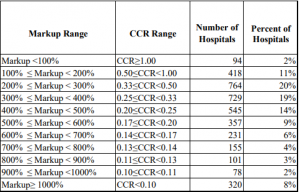
A new report from the Moran Company offers important insight into hospital charge and reimbursement levels. According to Moran, hospitals are generally not paid 100% of billed charges; however, hospital outpatient departments are routinely reimbursed as a percent of billed charges by commercial payers. In the hospital outpatient setting, surveyed payers indicate that 54% of covered lives had their services reimbursed under a percent of charges model. More than half of payers surveyed (51%) indicate that percent of billed charges remains the most common reimbursement mechanism in the hospital outpatient setting for single source, brand specialty medicines.

According to the report, there is also evidence of a correlation between increased hospital charges and increased reimbursed amounts to hospitals by private payers. High hospital charges can also be passed along directly to uninsured patients and other groups who have not negotiated rates with the hospital, leading to financial hardship for patients and increased premiums for automotive and workers’ compensation insurance. Moran found that on average, hospitals charge 479% of their cost for drugs nationwide. The report suggests that most hospitals (83%) charge patients and insurers more than double their acquisition cost for medicine, marking-up the medicines 200% or more. The majority of hospitals (53%) markup medicines between 200% and 400%, on average.


A small share of hospitals (17%) charges seven times the price of the medicine. On a medicine with an average sales price of $150, a 700% markup would result in a charge of $1,050. One out of every 12 hospitals (8%) has average charge markups greater than 1000%; meaning they are charging at least 10 times their acquisition cost for medicines, on average (Figure 1). Moran used the 2016 cost reports from the Healthcare Cost Report Information System in their analysis. Hospitals with a full year of cost report data in 49 states and D.C. were included. Hospitals in Maryland were excluded since they are paid under a waiver program that is atypical from other payment systems. The four-page report is available online.

Please contact your Conner Strong & Buckelew account representative toll-free at 1-877-861-3220 with any questions.

​SEC Settles with Elon Musk and Tesla over Take-Private Tweets

BACKGROUND

During the trading day on August 7, 2018, Musk issued a series of tweets in which he not only said that funding for the take-private transaction was secured, but that the only thing remaining in order for the transaction to be completed was a shareholder vote (implying that it had already been approved by the company’s board of directors).

The SEC’s complaint against Musk alleges that he did meet on July 31, 2018, with representatives of a sovereign wealth fund, in which, among other things, a possibility of a take-private transaction was raised. However, the SEC alleges that the July 31st meeting lacked discussion of even the most fundamental terms of a proposed going-private transaction. The discussion did not include any dollar amount or specific ownership percentage for the transaction; the fund’s available liquid capital; any regulatory hurdles; or the process for securing board approval. Musk later acknowledged that no specific term deals were discussed at the meeting and that nothing was exchanged in writing. Musk did not meet with the fund representatives again until August 10th, three days after his August 7th Twitter storm.

The complaint also alleges that on August 2nd, Musk sent the board an email entitled “Offer to Take Tesla Private at $420.” Musk did not discuss the $420 price with any funding source prior to sending the email. Musk later said there was “a lot of uncertainty” regarding the possible transaction. In an August 3rd phone call with the board, Musk expressed his hope that many shareholders would stay with the company even if the company went private. He asked for the board’s authorization to contact shareholders to sound out their interest in the proposed deal.

The complaint alleges that between July 31, 2018 and August 7, 2018, Musk did not discuss a take-private transaction at $420 per share with any other funding source, did not provide Tesla’s board with a more specific proposal to take Tesla private, did not retain any advisors, did not contact any retail investors or determine whether institutional investors had restrictions on holding what would be illiquid shares if Tesla were to go private, and did not determine what regulatory approvals would be required for a take-private transaction.

Notwithstanding all of these limitations, Musk nevertheless launched his tweets during the day on August 7th. The SEC’s complaint alleges that following the first of Musk’s tweets, Tesla’s share price rose over 6% and it closed the day up over 10%. The complaint shows that Musk’s tweets clearly caught not only investors and analysts by surprise, but caught company officials by surprise as well.

On August 24th, after the close of trading, Tesla published a blog post stating that Musk had abandoned the process of trying to take Tesla private.


THE SEC’S COMPLAINT AGAINST MUSK

In alleging that Musk’s Twitter statements on August 7th had been false and misleading, the SEC stated that “Musk’s statements that funding was ‘secured’ and investor support was ‘confirmed’ were false and misleading because, in reality, Musk had not ‘secured’ or ‘confirmed’ commitment from any source to provide any amount of funding.” In addition, he had never even discussed taking Tesla private at a price of $420 per share with the Fund or any other potential investor. The SEC alleged that Musk’s statement that the only remaining contingency was a shareholder vote was also false and misleading because no formal proposal had ever been presented to the board. The SEC also alleged that there were numerous omissions from his disclosures of facts that were known to him, including the relative limitation of his discussions with the sovereign wealth fund and with the board.

The complaint alleged that by engaging in this conduct, “Musk violated and unless restrained and enjoined, will violate again” Section 10(b) of the Securities and Exchange Act of 1934 and Rule 10b-5 thereunder. The complaint sought injunctive relief, disgorgement, civil penalties, and a bar prohibiting Musk from serving as an officer or director of any public company.


THE SETTLEMENT

As detailed in a September 29th press release, the SEC, Musk, and Tesla reached a settlement of the enforcement action. According to the press release, Musk agreed to pay the agency $20 million and step down as the company’s Chairman. The agency’s action against Tesla was also resolved as part of the SEC’s settlement with Musk. In its complaint against Tesla, the agency alleged that Tesla had failed to institute required disclosure controls and procedures relating to Musk’s tweets, a charge that Tesla agreed to settle. As part of the settlement, the company also agreed to pay a $20 million penalty, adopt certain governance reforms, appoint an independent Chairman, and appoint two independent directors. The $40 million in penalties is to be distributed to harmed investors as part of a court-supervised process. The settlement is subject to court approval.


DISCUSSION

This is the first SEC enforcement action based on alleged misrepresentations or omission in statements on Twitter. Further, John Reed Stark, President of John Reed Stark Consulting and former Chief of the SEC’s Office of Internet Enforcement, states that a close reading of the SEC’s complaint against the celebrated billionaire finds a litany of glaring absences within the SEC’s allegations, including:

  • No alleged profits or other ill-gotten gains earned by Musk;
  • No alleged scheme conducted by Musk;
  • No alleged market manipulation orchestrated by Musk;
  • No alleged pump and dump ploy executed by Musk;
  • No alleged conspiracy between Musk and anyone else;
  • No alleged evidence of scienter or intent by Musk;
  • No alleged false filing or other false or inaccurate Tesla report to the SEC by Musk;
  • No alleged violation of any sort of required SEC “quiet period” by Musk.

Of importance, the SEC makes a point in its press release that the securities laws apply even to statements made within the relatively informal and less structured world of social media. The press release quotes Stephanie Avakian, Co-Director of the SEC’s Enforcement Division, as saying that the obligation to provide investors with truthful information “applies with equal force when the communications are made via social media or another nontraditional form.”

The circumstances of this case underscore the dangers to public companies when company executives use social media for communicating with investors. The media’s informality and unstructured environment create their own perils, but those dangers are magnified if an executive uses the media impulsively and without the kind of oversight, review, and scrutiny that would be employed in communications about corporate transactions using more traditional means. The SEC’s complaint highlights the dangers involved under these kinds of circumstances: “Musk made his false and misleading public statements about taking Tesla private using his mobile phone in the middle of the active trading day. He did not discuss the content of the statements with anyone else prior to publishing them to his over 22 million Twitter followers and anyone else with access to the Internet. He also did not inform Nasdaq that he intended to make this public announcement, as Nasdaq rules required.”

The SEC’s complaint makes it clear that corporate executives who mislead investors, as Musk is alleged to have done, are not going to be let off the hook or given any leeway merely because the medium used to communicate is one of relative informality, like Twitter. Musk’s statements clearly had a significant market impact, without respect to the fact that the statements appeared only on social media.

Of all the many interesting things about the SEC’s complaint, perhaps the most interesting is the SEC’s initial request for an officer and director bar against Musk. Ultimately, the SEC did not insist on an officer and director bar as part of its settlement; Musk agreed only to step down as the company’s Chairman, while being permitted to continue as the company’s CEO. Notwithstanding the compromise, the SEC’s message seems clear, that it intends to pursue claims against corporate officials for alleged misrepresentations, and its pursuit will include even the most far-reaching remedies.

The final message is that the SEC intends to pursue claims for any statements which allegedly mislead investors, regardless of who made the statements and regardless of the medium used to make the statement.


ABOUT THE AUTHOR

This article was prepared by Kevin M. LaCroix, Esq. of RT ProExec. Kevin has been advising clients concerning directors’ and officers’ liability issues for nearly 30 years. Prior to joining RT ProExec, Kevin was President of Genesis Professional Liability Managers, a D&O liability insurance underwriter. Kevin previously was a partner in the Washington, D.C. law firm of Ross Dixon & Bell.

Kevin is based in RT ProExec’s Beachwood, Ohio office. Kevin’s direct dial phone number is (216) 378-7817, and his email address is [email protected].


ABOUT RT PROEXEC

RT ProExec is the Professional & Executive Liability Division of R-T Specialty, LLC. R-T Specialty, LLC is an independent wholesale insurance brokerage firm that provides Property, Casualty, Transportation and Professional & Executive Liability insurance solutions to retail brokers across the country. Our proven leadership, deep talent pool, and commitment to coverage and service has made us one of the largest wholesalers in the Professional & Executive Liability insurance marketplace.


ABOUT CONNER STRONG & BUCKELEW

Conner Strong & Buckelew is among America’s largest insurance brokerage, risk management and employee benefits brokerage and consulting firms. The firm is an industry leader in providing high-risk businesses with comprehensive solutions to prevent losses, manage claims, and drive bottom-line growth. Its employee benefits practice focuses on providing best-in-class benefits administration, health and wellness programs and strategic advisory services.

The company provides insurance and risk services to a wide range of industries including but not limited to aviation, construction, education, healthcare, hospitality & gaming, life science & technology, public entity and real estate. Additionally, Conner Strong & Buckelew and its affiliates offer a number of innovative and specialty solutions which include captive strategies, construction wrap-ups, executive risk, safety and risk control, and private client services.

Founded in 1959 with offices in New York, New Jersey, Pennsylvania, Georgia, Massachusetts, and Delaware, Conner Strong & Buckelew has a team of nearly 400 professionals, serving clients throughout the United States and abroad.


DISCLAIMER

This article is provided for informational purposes only and is not intended to provide legal or actuarial advice. The issues and analyses presented in this article should be reviewed with outside counsel before serving as the basis of any legal or other decision.

Why Tactical Planning Doesn’t Work

“It is what it is.”

That’s the mantra of most life science firms when it comes to insurance renewals. Every year, it’s the same. Your renewal comes up. You look at your deductibles and evaluate if there are many ways to save money next year. Your insurance carrier pushes back, unwilling to negotiate. So you renew. It is what it is.

Long-term strategic insurance planning is a foreign concept to many life science firms. Securing insurance is seen as a tactical function, not a strategic priority.

But aligning your insurance program to your one- to three-year business plan is critical, especially if you’re a high-growth firm nearing commercialization. Your growth strategy should dictate the amount of risk you can and should retain over time and the best vehicle to deliver your coverage. Planning ahead also gives you more power in the marketplace – to find the most effective carrier partner, negotiate the best possible rates and properly account for your insurance costs in your financials.

In mapping out your strategic insurance program, there are three things to consider:

  1. Your risks

    A lot can change in a year. Your firm may acquire a company, product or ingredient; add a new third party to your supply chain; strike a new licensing deal; or begin a new clinical trial. Any one of these changes can introduce new liabilities for your organization, and failing to properly plan for these risks could result in coverage gaps, inadequate insurance limits or an unexpected jump in your insurance costs. By anticipating and preparing for these changes, you can ensure your coverage reflects your current risks and also negotiate rates with your carrier – which becomes more difficult once you’ve already acquired a new risk. What’s more, you can incorporate these rates into your annual budget.

  2. Your risk tolerance

    Your risk tolerance is the specific, quantifiable measure of the levels of risk your firm is willing to retain. It establishes the number of losses you can sustain without adversely affecting the business. Especially when you’re positioned for growth or increased earnings, it’s critical to map out your long-term risk tolerance. It starts with considering the metrics that matter most to your business – earnings per share, credit ratings or other balance sheet indicators. From there, you can determine at what point a retained loss will cause your firm financial pain and the best way to chart that over time. By bringing a knowledgeable broker into the planning process, you can more strategically map your risk tolerance against your current and future market positions, ensuring your insurance program can mature alongside your business.

    Your broker can also help you control your story and message to the insurance marketplace. Too often, carriers will continuously charge companies for their growth, even when the structure of their policy no longer makes sense. By getting out in front of the marketplace, your broker can identify the best carrier partner for your growing business and negotiate the most cost-effective
    program at your desired retention.

  3. The best vehicle for your insurance program

    As your firm grows, purchasing first-dollar insurance coverage can become untenable. This policy structure relies on high premiums rather than triggering a deductible after covering a loss, and it becomes increasingly costly as your firm grows.

    When laying out your long-term insurance program, it’s important to evaluate all options for structuring your coverage. This is especially important if your firm will be taking on more risks in the coming years.

    There are a number of ways to fund these risks, from insurance policies written with deductibles to self-insured retentions. There are also more creative approaches, such as a captive insurance program. An alternative to self-insurance, captives provide individual companies or groups of companies the opportunity to keep the profits typically earned by insurance carriers when losses are low.

    In the life sciences world, captives have historically been used primarily by large corporations with unique levels of risk. However, middle market firms have begun using captives to structure their employee benefits. This approach, which gives companies more control over their insurance program costs, can more easily scale when a firm is growing quickly and needs to rapidly hire employees.

    Transitioning from a tactical to a strategic insurance program often requires organization-wide support. Working with a specialist broker who serves firms from start-up stage through commercialization and beyond can help streamline the process.

Daniel Brettler and Timothy Gosnear lead Conner Strong & Buckelew’s Life Science Practice, where they design comprehensive risk solutions and insurance programs for development stage companies through large enterprises.

Download a copy of this article here.

Summer Jobs Come with Safety Risks for Young Employees

Ran in Business Insurance in July 2018.
BY ERIC VOIGHT

Summer job season is in full swing, with the influx of younger workers creating workplace safety challenges for employers.

Broadly speaking, workers between the ages of 14 and 24 are likely to injure themselves on the job because of their inexperience as well as their physical, cognitive and emotional developmental characteristics, according to the U.S. Occupational Safety and Health Administration.

From April to July 2017, the number of employed 16- to 24-year-olds increased by 1.9 million to 20.9 million, according to the U.S. Bureau of Labor Statistics.

In 2016, 13 workers under the age of 16 died from occupational injuries out of a total of 5,190 fatalities, according to bureau data. Seventeen workers between the ages of 16 and 17 died on the job that year, compared with 43 in the 18-to-19 age group and 310 workers aged 20 to 24, according to bureau data.

Employers hiring young employees should take steps to reduce the injury and illness risk to this group, experts say. For example, employers should ensure these young employees have the proper licenses for the tasks they are hired to perform, including drivers’ licenses given the risk of driving-related fatalities for this age group. Younger employees working at landscaping companies or recreational centers, for example, may be transporting equipment or other people, so employers need to conduct a driving background check, said Woody Dwyer, second vice president of workers compensation, risk control at Travelers Cos. Inc. based in Hartford, Connecticut.

For summer camps, counselors need to have lifeguard certifications, rifle training, archery training and other preparation for various outdoor activities, said Jim Chalmers, vice president of Chalmers Insurance Group based in Bridgton, Maine. Employers must rethink their training methods because asking workers to watch 15- to 20-minute videos in a classroom or online is ineffective in his experience, said Eric Voight, vice president and assistant director of risk control at Conner Strong & Buckelew based in Marlton, New Jersey. Interactive training is ideal for younger workers, millennial workers in particular, because they like to know the rationale behind rules rather than older workers who are “more
accustomed to an authoritarian teaching style,” Mr. Voight said in a follow-up email.

Some employers assume that an orientation is enough, but young workers across many sectors require separate safety training to understand all the risks involved with a particular job, Mr. Dwyer said. Retail workers, for example, might fall off a ladder, get hit in the head by falling inventory or suffer from lacerations when handling inventory, he said. While working outdoors, new landscapers should be taught to look for signs of heat stress. Food service workers are more susceptible to burns or slips and falls, Mr. Dwyer added.

“Don’t assume that they have the same safety expectations as you,” Mr. Dwyer said. “You need to make sure (workers) have an understanding of the risk and what are our procedures.”

It’s important for employers to create a safety-first work environment from the beginning, coaching fewer workers as they become acquainted with the job, said Erin Cullen, the New York-based customer group president of ProSight Global Inc. General contractors are incentivized to complete jobs on schedule, and newer workers mistakenly think that they can cut corners to complete tasks, but employers must urge all of their workers — their new workers especially — to follow their older colleagues, Ms. Cullen said.

Young employees may come into the worksite and want to perform the job more efficiently, Ms. Cullen said. “It’s kind of that millennial mindset of ’I can figure this out,’” she said. “We’re actually seeing younger workers having more injuries on-site because they’re choosing to not follow protocol in some scenarios.”

For construction sites, new wearable technologies can be used for older and younger workers alike, but they’re especially useful for shortening the learning curve for younger and inexperienced seasonal workers while lessening the time spent looking after new employees, said Martin Frappolli, director of knowledge resources at The Institutes Risk and Insurance Knowledge Group in Malvern, Pennsylvania. These tools can alarm workers when they are about to enter the wrong zone, detect slips and falls, and notify them when they need to evacuate, Mr. Frappolli added.

In the construction space, Mr. Dwyer recommended pairing younger workers with more experienced workers — those with at least five to 10 years of experience — and giving them a distinctive hard hat or T-shirt so veteran workers can keep an eye on them.

Employers also need to ensure that young employees have the proper clothing and equipment, particularly when working outdoors. Youth camp counselors, for example, must wear the proper footwear — no flip-flops — to avoid slips and falls while hiking, Mr. Chalmers said. It is also critical for counselors to take adequate breaks on or off campgrounds, he said.

“We all need a few minutes to rest and relax,” Mr. Chalmers said. “Rest, hydration — all of those keep your energy levels up for working with kids.”

Download a copy of this article here.

Hurricane Preparedness, Loss Remediation & Claim Reporting

As you may know, we are in the height of hurricane season and are currently tracking three hurricanes located in the Atlantic.

Of foremost concern is Hurricane Florence. The National Hurricane Center upgraded this storm to a Category 4 and is predicting landfall in both North & South Carolina this Thursday, September 13, 2018.

Weather Tracking & Preparedness Information

Important Reminders Should You Sustain a Loss

  • For damage to your property, call an emergency services & loss remediation company immediately; otherwise you may have to wait to get someone out to your property. See phone numbers below.
  • Take the steps to protect your property from further damage.
  • Document the damage and the steps you are taking.
  • Set aside damaged property for further inspection by your insurance company – do not discard it!
  • Take pictures and/or video of the loss and all damaged property.
  • If your business is damaged, take the necessary steps to re-establish your business operations.
  • All documentation should be forwarded to your Conner Strong & Buckelew Claim Consultant.

Emergency Services & Loss Remediation

You may need a company to assist with the clean-up efforts of your property. We suggest you call someone immediately. We have had experience in the South-East Region with the following companies:

Should you have any questions, please contact us at [email protected].

This is a time-sensitive article and the information may be outdated. Please look at the time stamp on the story to see when it was last updated.  Additional information and resources can be found on our Emergency Claims Reporting page.

Insurance Policy Pitfalls: Why Tactical Insurance Planning Doesn’t Work

BY DANIEL BRETTLER

“It is what it is.”

That’s the mantra of most life science firms when it comes to insurance renewals. Every year, it’s the same. Your renewal comes up. You look at your deductibles and evaluate if there are any ways to save money next year. Your insurance carrier pushes back, unwilling to negotiate. So you renew. It is what it is.

Long-term strategic insurance planning is a foreign concept to many life science firms. Securing insurance is seen as a tactical function, not a strategic priority. But aligning your insurance program to your one- to three-year business plan is critical, especially if you’re a high-growth firm nearing commercialization. Your growth strategy should dictate the amount of risk you can and should retain over time and the best vehicle to deliver your coverage. Planning ahead also gives you more power in the marketplace – to find the most effective carrier partner, negotiate the best possible rates and properly account for your insurance costs in your financials.

In mapping out your strategic insurance program, there are three things to consider:

1. Your risks
A lot can change in a year. Your firm may acquire a company, product or ingredient; add a new third party to your supply chain; strike a new licensing deal; or begin a new clinical trial.

Any one of these changes can introduce new liabilities for your organization, and failing to properly plan for these risks could result in coverage gaps, inadequate insurance limits or an unexpected jump in your insurance costs.

By anticipating and preparing for these changes, you can ensure your coverage reflects your current risks and also negotiate rates with your carrier – which becomes more difficult once you’ve already acquired a new risk. What’s more, you can incorporate these rates into your annual budget.

2. Your risk tolerance
Your risk tolerance is the specific, quantifiable measure of the levels of risk your firm is willing to retain. It establishes the amount of losses you can sustain without adversely affecting the business. Especially when you’re positioned for growth or increased earnings, it’s critical to map out your long-term risk tolerance.

It starts with considering the metrics that matter most to your business – earnings per share, credit  ratings or other balance sheet indicators. From there, you can determine at what point a retained loss will cause your firm financial pain and the best way to chart that over time.

By bringing a knowledgeable broker into the planning process, you can more strategically map your risk tolerance against your current and future market positions, ensuring your insurance program can mature alongside your business.

Your broker can also help you control your story and message to the insurance marketplace. Too often, carriers will continuously charge companies for their growth, even when the structure of their policy no longer makes sense. By getting out in front of the marketplace, your broker can identify the best carrier partner for your growing business and negotiate the most cost-effective program at your desired retention.

3. The best vehicle for your insurance program
As your firm grows, purchasing first-dollar insurance coverage can become untenable. This policy  structure relies on high premiums rather than triggering a deductable after covering a loss, and it becomes increasingly costly as your firm grows.

When laying out your long-term insurance program, it’s important to evaluate all options for structuring your coverage. This is especially important if your firm will be taking on more risks in the coming years.

There are a number of ways to fund these risks, from insurance policies written with deductibles to self-insured retentions. There are also more creative approaches, such as a captive insurance program. An alternative to self-insurance, captives provide individual companies or groups of companies the opportunity to keep the profits typically earned by insurance carriers when losses are low.

In the life sciences world, captives have historically been used primarily by large corporations with unique levels of risk. However, middle market firms have begun using captives to structure their employee benefits. This approach, which gives companies more control over their insurance program costs, can more easily scale when a firm is growing quickly and needs to rapidly hire employees.

Transitioning from a tactical to a strategic insurance program often requires organization-wide support. Working with a specialist broker who serves firms from start-up stage through commercialization and beyond can help streamline the process.
Planning ahead also gives you more power in the marketplace – to find the most effective carrier partner, negotiate the best possible rates and properly account for your insurance costs in your financials.

Daniel Brettler and Timothy Gosnear lead Conner Strong & Buckelew’s Life Science Practice, where they design comprehensive risk solutions and insurance programs for development stage companies through large enterprises.

Click here to download a copy of this article.