Category: Legislative Updates

More Guidance on HRAs Integrated with Individual Health Insurance

We recently released an Update summarizing new proposed regulations that would expand the usability of health reimbursement arrangements (HRAs) if certain conditions are met. The proposed rules would establish two new types of HRAs that would be available to employers of any size and would permit HRAs that are integrated with individual health insurance coverage (ICHRAs), subject to certain conditions. If finalized, the proposed rules would be effective for plan years beginning on or after January 1, 2020.

The IRS has now also issued IRS Notice 2018-88 inviting comments regarding application of the employer shared responsibility (mandate) rules and the self-insured health plan Code section 105(h) nondiscrimination rules to ICHRAs. The notice proposes regulatory positions and requests comments on various issues, but it does not provide guidance on which taxpayers may rely.

  • Employer Shared Responsibility – The notice clarifies the expected application to ICHRAs of certain employer shared responsibility rules (which were not addressed in the proposed regulations) and describes several potential affordability safe harbors. ICHRAs would be considered eligible employer-sponsored plans, so an applicable large employer (ALE) could count ICHRA offers toward the 95% threshold for avoiding employer mandate penalties.
  • Nondiscrimination – Because the proposed regulations would allow employers to limit offers of ICHRAs to certain classes of employees and to vary contribution amounts among the classes, the IRS anticipates issuing guidance providing that an ICHRA would not fail to meet the self-insured plan nondiscrimination requirement for uniform employer contributions so long as the same terms and maximum dollar limit apply to all employees within a particular class. However, an employer generally could increase ICHRA contributions for older participants commensurate with age-based premium increases without violating the uniform contribution rule.

While the proposed ICHRA approach may not fit the benefit strategies for many employers, it may be attractive to those employers and employees who are seeking a more defined contribution approach to health care coverage. Employers interested in adopting ICHRAs effective in 2020 will want to stay tuned for more information on these proposals. Conner Strong & Buckelew will provide alerts and updates as new information becomes available. Should you have questions, contact your Conner Strong & Buckelew account representative toll free at 1-877-861-3220. For a complete list of Legislative Updates issued by Conner Strong & Buckelew, visit our online Resource Center.

​Final Rules on Religious Objections and Contraceptive Coverage Under the ACA

Two newly released final rules provide conscience protections to those who have a religious or moral objection to health insurance that covers contraceptive methods and/or sterilization procedures. Under the final rules, a covered plan sponsor, issuer or plan that properly claims an exemption will not be penalized for failing to include contraceptive coverage in the plan’s benefits. However, any entity may face fines and lawsuits for not complying with the contraceptive coverage mandate. As in the prior rules, both the religious and moral final rules extend the exemption (and the accommodation) to certain non-governmental employers (including for-profit companies, whether they are closely-held or not) and institutions of higher education with “sincerely held religious beliefs” or “sincerely held moral convictions” opposed to offering coverage of some or all contraceptive or sterilization methods. No new notice requirements are imposed, but the rules do note that existing ERISA rules governing group health plans would apply and “… therefore, if an objecting employer would like to exclude all or a subset of contraceptive services, it must ensure that the exclusion is clear in the plan document. Moreover, if there is a reduction in a covered service or benefit, the plan has to disclose that change to plan participants. Thus, where an exemption applies and all or a subset of contraceptive services are omitted from a plan’s coverage, otherwise applicable ERISA disclosures must reflect the omission of coverage in ERISA plans.”

Background
Under the Affordable Care Act (ACA) and its implementing regulations, FDA-approved contraceptive methods, sterilization procedures, and related education and counseling are included in the list of preventive services that must be covered without cost sharing under non-grandfathered health plans. The Obama administration provided for a narrow exemption for churches, religious orders, and integrated auxiliaries (organizations with financial support primarily from churches), and there was an accommodation for religious non-profits. And after the Supreme Court’s Hobby Lobby decision, there was a further accommodation for closely held for-profit organizations that had religious objections to covering some or all contraceptives. Under the accommodation, the entity’s insurer or third party administrator was responsible for providing contraceptive services to the entity’s plan participants and beneficiaries.

The Trump administration inherited dozens of lawsuits filed by organizations with sincerely held religious or moral objections to paying for or providing contraceptive or abortion-inducing drugs and devices. In October 2017, two interim final rules were issued seeking public comment. See our Update. The rules protected conscientious objections to the federal contraceptive guidelines, while maintaining the contraceptive coverage requirement in nearly all cases. The administration received over 100,000 public comment submissions by the December 2017 deadline. In three lawsuits (currently on appeal) filed against the interim final rules, the government won one, while two judges enjoined enforcement of the interim final rules. In many cases filed against the contraceptive mandate promulgated by the previous administration, courts have granted permanent injunctions protecting non-profit organizations from the contraceptive mandate and accommodation.

Two Final Rules Concerning Religious and Moral Exemptions:
Exemptions for Religious Beliefs – This rule provides an exemption from the contraceptive coverage mandate to entities and individuals that object to services covered by the mandate on the basis of sincerely held religious beliefs. Thus, entities that have sincerely held religious beliefs against providing contraceptive services (or services which they consider to be abortifacients) would be exempt from the mandate and no longer be required to provide such coverage. The rules maintain the availability of the accommodation, in which the entity’s insurer or third party administrator is responsible for providing contraceptive services to the entity’s plan participants and beneficiaries, but they make it voluntary, at the option of the entity. That is, an otherwise exempt entity can elect to take advantage of the accommodation, which would provide contraceptive coverage to its employees and their dependents. Entities that object to covering some, but not all, contraceptive items would be exempt with respect to only those methods to which they object. The exemption is also applicable to institutions of higher education, insurance issuers to the extent they provide a plan to otherwise exempt entities, and individuals whose employers and issuers are willing to provide them a plan compliant with the individuals’ beliefs. The final rule differs from the interim final rule in technical ways to ensure the text and operation of the rule is clear, and that insurers can rely on its procedures.

Exemptions for Moral Convictions – This rule gives nonprofit organizations, small businesses, and individuals that have non-religious moral convictions opposing services covered by the contraceptive mandate protections that are similar to the religious final rule’s protections for religious organizations and businesses. The exemptions apply to nonprofit organizations and to closely held businesses, as well as to institutions of education, health insurance issuers serving exempt entities, and individuals. The voluntary accommodation is also available to entities with moral convictions against providing contraceptive services (or services which they consider to be abortifacient) in their health plans. The moral exemption is not extended to publicly traded businesses or government entities. The final rule differs from the interim final rule in technical ways to ensure the text and operation of the rule is clear. Based on case law, the preamble to the rule explains that moral convictions are protected in ways similar to religious beliefs, when the convictions are those: (1) that a person “deeply and sincerely holds”; (2) “that are purely ethical or moral in source and content; (3) “but that nevertheless impose … a duty”; (4) and that “certainly occupy … a place parallel to that filled by … God’ in traditionally religious persons,” such that one could say the “beliefs function as a religion.”

Notices
The expanded exemptions use the same approach as under the prior rules, under which exempt groups are not required to file notices. Therefore, self-certification is optional and employers who claim an exemption may voluntarily provide self-certification or notice to the government. However, if an entity improperly claims an exemption, it risks fines and lawsuits for not complying with the contraceptive coverage mandate. If an exempt group wishes to use the optional accommodation process, it may file the same kind of form or notice required under the previous accommodation process (forms are being updated in conjunction with the final rules).

Effective Date and Impact
The rules will take effect on January 14, 2019. The rules leave in place contraceptive coverage guidelines where no religious or moral objection exists, and they do not change the Health Resources and Services Administration (HRSA) authority to decide whether to include contraceptives in the women’s preventive services guidelines for other entities.

  • The ACA itself exempts people who are in grandfathered coverage that existed prior to the ACA from the preventive services coverage mandate.
  • The rules leave in place government programs that provide free or subsidized contraceptive coverage to low income women, such as through community health centers.
  • The rules do not ban any drugs or devices, or prohibit any employer from covering contraceptives.
  • The rules exempt publicly traded religious entities if they object to contraceptive coverage.
  • The rules do not exempt publicly traded entities that have non-religious moral objections. The only entities known to express non-religious moral objections are pro-life organizations whose employees share the objections.

For most employers, these rules won’t be a cause for action as most employer plans cover contraceptives. Should you have questions about this or any aspect of healthcare reform, contact your Conner Strong & Buckelew account representative toll free at 1-877-861-3220. For a complete list of Legislative Updates issued by Conner Strong & Buckelew, visit our online Resource Center.
NJ Adopts Website to Promote Health Insurance Enrollment

This past summer the New Jersey state legislature enacted its own individual health care mandatethat requires New Jersey residents to obtain health coverage or pay a penalty. The law was passed in response to Congress’ decision to repeal the federal individual mandate established under the Affordable Care Act (ACA) and is a continuation of the ACA provision requiring New Jersey residents to obtain health insurance throughout 2019 or make a Shared Responsibility Payment when they file their 2019 New Jersey Income Tax return. The New Jersey individual mandate law takes effect on January 1, 2019 and includes employer reporting requirements that will be similar to the federal ACA reporting requirements. New Jersey has also launched a new website, GetCovered.NJ.gov, to promote health insurance enrollment and as a means to coordinate public awareness about plan options, as well as contact information for navigators and enrollment assisters who can help residents access coverage. State agencies and departments that regularly interact with the public are also expected to disseminate materials and educate residents on health coverage options and the availability of financial assistance. See the Governor’s press release for more information.

New Jersey’s Individual Mandate: The New Jersey individual mandate closely mirrors the federal ACA individual mandate in terms of the amount of the penalty, the minimum essential coverage (MEC) standard (with some important exceptions), and the administration of the penalty via the tax system. Under the new law, New Jersey taxpayers who are subject to the individual mandate (and their dependents) must have MEC during each month of the year beginning January 1, 2019. Those without MEC may be subject to a penalty that is equal to the amount they would have paid if the ACA’s mandate had not been repealed: $695 for adults ($347.50 per child) or 2.5 percent of a taxpayer’s income, whichever is greater (as adjusted). The hope is that the state-level mandate will incentivize coverage among healthy individuals who might not otherwise purchase insurance following repeal of the federal ACA individual mandate penalty.

Impact on Employer Plans: The New Jersey individual mandate will not likely have much, if any, impact on employer provided health plans. However, certain entities, such as employers of all sizes that offer employer-based health coverage (whether fully insured or self-insured), insurers, and the New Jersey Department of Human Services, will have to submit a return to the state treasurer to include data on individuals covered under MEC such as names, Social Security numbers, dates of coverage, and other information requested by the treasurer.

New Jersey’s individual mandate is one of the first to be effective post the Trump administration’s repeal of the ACA individual mandate. Employers sponsoring both fully-insured and self-insured plans that cover New Jersey residents should stay tuned for clarifying regulations on the reporting requirements, as details are yet to be released on the reporting aspects of this new law. We will continue to provide updates on the New Jersey reporting rules as further information becomes available. Contact your Conner Strong & Buckelew account representative toll free at 1-877-861-3220 should you have any questions. For a complete list of Legislative Updates issued by Conner Strong & Buckelew, visit our online Resource Center.


Proposal to Expand the Use of Health Reimbursement Accounts

A new proposed regulation would expand the usability of health reimbursement arrangements (HRAs) if certain conditions are met. If finalized, the proposal would be effective for plan years beginning on or after January 1, 2020. This proposed regulation is in response to President Trump’s Executive Order on “Promoting Healthcare Choice and Competition Across the United States” and fulfills the President’s commitment to foster competition and choice, and to provide employees who work at small businesses with more options for financing their healthcare. For more, see the DOL Press Release and Fact Sheet.

Current Law

HRAs allow employers to reimburse their employees for medical expenses in a tax-favored way. HRAs are funded solely by employer contributions that reimburse an employee for medical expenses incurred by the employee or the employee’s spouse and dependents up to a maximum dollar limit per covered period. HRA reimbursements are excluded from income and payroll taxes and unused amounts at the end of a year may carry over to later years, depending on the terms of the HRA. Current rules prohibit large employers from using HRAs to reimburse employees for the cost of individual health insurance coverage.

Proposed Changes

The proposed rules would permit HRAs to reimburse employees for the cost of individual health insurance coverage, subject to certain conditions. These conditions mitigate the risk that health-based discrimination could increase adverse selection in the individual market, and include a disclosure provision to ensure employees understand the benefit. The proposed regulation would not alter the tax treatment of traditional employer-sponsored coverage. It would merely create a new tax-preferred option for employers of any size to use when funding employee health coverage. While the employer would fund the cost of individual health insurance coverage, the employee would own the coverage, allowing the employee to keep the coverage even if he or she left the employer and was no longer covered by the HRA.

Two new types of HRAs would be available:

  • The proposal, once finalized, would permit HRAs to reimburse premiums for individual health insurance policies only if all individuals covered by the HRA verified that they are, or will be, enrolled in individual health insurance coverage. Also, the HRA must be offered on the same terms to all employees within a defined class, and no class of employees can be offered a choice between a traditional group health plan and the HRA. Participants must be permitted to opt out of the HRA annually, and employers must provide eligible participants with a written notice describing the features of the HRA.
  • Separately, in addition to allowing HRAs to reimburse the cost of individual health insurance coverage, the proposed regulation would allow employers offering traditional employer-sponsored coverage to offer an “excepted benefit” HRA of up to $1,800 per year (indexed annually for inflation) to reimburse an employee for certain qualified medical expenses, including premiums for short-term, limited-duration insurance plans.

Other proposed details include:

  • ERISA – The terms “employee welfare benefit plan” and “welfare plan” as used in ERISA would not include individual health insurance funded by an HRA if certain requirements are met. Among other things, the purchase of the insurance must be completely voluntary for participants and beneficiaries; the employer or other plan sponsor must not select or endorse any particular insurer or coverage; and participants must be notified annually that the individual coverage is not subject to ERISA.
  • Cafeteria Plans – Employers with HRAs that are integrated with individual health insurance could allow employees to use pre-tax cafeteria plan salary reductions to pay any portion of their individual insurance premiums not covered by the HRA. If offered, salary reductions would have to be made available on the same terms and conditions to all employees within a class.
  • Premium Tax Credit – Proposed rules would provide guidance regarding the premium tax credit consequences for individuals who are offered or covered by an HRA that is integrated with individual health insurance.
  • Exchange Special Enrollments – Proposed rules would establish an exchange special enrollment period for employees and their dependents who gain access to an HRA that is integrated with individual health insurance coverage, allowing them to enroll in individual insurance coverage or change from one individual coverage plan to another.

If finalized as proposed, the rules will establish two new types of HRAs that would be available to employers of any size. While the proposed HRA approach may not fit the benefit strategies for all employers, it may be attractive to those employers and employees who are seeking a more defined contribution approach to health care coverage. Conner Strong & Buckelew will provide alerts and updates as new information becomes available. Should you have questions, contact your Conner Strong & Buckelew account representative toll free at 1-877-861-3220. For a complete list of Legislative Updates issued by Conner Strong & Buckelew, visit our online Resource Center.

Proposed Legislation to Amend the ACA’s 30-Hour Rule

The US House of Representatives is planning to vote on legislation that would change the definition of a full-time worker under the Affordable Care Act (ACA), raising it to 40 hours a week, up from the law’s current standard of 30 hours, among other changes to the law. The bill (H.R. 3798) is named the Save American Workers Act and includes provisions to address and modify various aspects of the ACA. According to press accounts, the bill has 77 sponsors, including 72 Republicans and 5 Democrats.

Under the current law, businesses with 50 or more employees working an average of at least 30 hours a week must offer health coverage or face fines. Businesses have objected to the 30-hour threshold saying it is too low given that 40 hours is the standard for a full week under federal overtime laws. The US Congressional Budget Office reported that the change from 30 to 40 would reduce federal revenue by $9.8 billion from 2019 to 2028. The proposed legislation grants retroactive relief from the employer mandate. Thus, any employer that owed a penalty for failing to provide coverage from January 1, 2015 to December 31, 2018 would no longer owe it. The legislation also would delay implementation of the so-called “Cadillac Tax” on high-premium health insurance plans until 2023. Overall, according to press accounts, the legislation would reduce federal revenue by $51.6 billion.

The House is expected to vote on the bill after the November midterm elections. In order to pass, the bill must first be approved by the US House and the US Senate before being approved by the President. As expected, business groups have spoken in support of the bill. We are following ACA proposed changes closely and will provide updates as applicable.

Please contact your Conner Strong & Buckelew account representative toll free at 1-877-861-3220 with any questions. For a complete list of Legislative Updates issued by Conner Strong & Buckelew, visit our online Resource Center.

Final 2018 ACA Reporting Forms Released

The Internal Revenue Service (IRS) has issued final 1095-A, 1094-B, 1095-B, 1094-C, and 1095-C forms that employers, plan sponsors, health insurers and the Marketplace will use to report health coverage information to applicable individuals and the IRS as required by the Affordable Care Act (ACA). Final instructions have also been issued.

Form 1095-C, Employer-Provided Health Insurance Offer and Coverage

Form 1094-C, Transmittal of Employer-Provided Health Insurance Offer and Coverage Information Returns

Instructions for Form 1094-C and Form 1095-C

Form 1095-B, Health Coverage

Form 1094-B, Transmittal of Health Coverage Information Return

Instructions for Forms 1094-B and Form 1095-B

Form 1095-A, Health Insurance Marketplace StatementInstructions  

The 2018 Forms and Instructions are largely unchanged from calendar year 2017. Employers and plan sponsors should take note of the timing requirements and review the information reporting requirements through IRS resources available at the Applicable Large Employer Information Center. Employers should also continue to be on the lookout for IRS penalty letters or notices related to past ACA filings and should immediately present any materials received to their ACA reporting vendors, legal counsel and qualified tax advisers.

Should you have questions about this or any aspect of federal health insurance reform, contact your Conner Strong & Buckelew account representative toll free at 1-877-861-3220. For a complete list of Legislative Updates issued by Conner Strong & Buckelew, visit our online Resource Center.

Important Wellness Regulation Update for 2019

Recent federal court action has called to question federal regulations related to requirements for wellness programs that ask participants questions about their health or require medical exams. This update is intended to provide some background and guidance on these regulations. Since the issue is complex, it is beneficial to first provide some history and the backdrop related to federal wellness rules. This is an important update so please review it thoroughly.

Background on EEOC Wellness Rules
In 2016, the federal Equal Employment Opportunity Commission (EEOC) issued final regulations addressing the extent to which certain wellness programs could offer incentives for participation and still satisfy requirements related to the Americans with Disabilities Act (ADA) exception for voluntary employee health programs. In general, the EEOC and ADA rules largely impact only those employers and plan sponsors that have wellness plans that ask medical questions (i.e. health risk appraisals, etc.) and/or require one to get an exam (i.e., bio-metric screenings, physical exams). Here are links to the Conner Strong & Buckelew regulatory updates we issued at the time related to the 2016 EEOC rules: 2016 Update and 2016 Notice Update.

Legal Challenges and Impact for 2019 and Beyond
In August of 2017, the American Association of Retired Persons (AARP) challenged the 2016 final EEOC/ADA regulations as being discriminatory. The court sided with the AARP and found that the EEOC’s interpretation of the term “voluntary” was neither reasonable nor supported by the administrative record. In the ruling, the court ruled that the EEOC failed to adequately establish that a 30% incentive did not render a wellness program involuntary. That is, the court rules that the EEOC/ADA regulations were really not “voluntary” at all. The court initially declined to vacate the rules and instead remanded them to the EEOC for reconsideration. Here is a link to our regulatory update on this issue at the time of the court’s ruling: 2018 Update.

In response to the court’s decision, the EEOC filed a status report advising the court that any substantively amended rules to the wellness would likely not be applicable until the beginning of 2021. As a result of the EEOC’s position, the court concluded that the proper remedy was to vacate the incentive provisions of the regulations as of January 1, 2019. As a result, until January 1, 2019 and subject to further action by the court or EEOC, the incentive provisions of the regulations remain in effect. Furthermore, in light of the court’s ruling, it appeared that new wellness guidelines would be issued and that the current rules in effect would no longer be allowed. The EEOC was expected to issue new updates to address the court’s directive and presumably create new standards around the 30% incentive rule and the use of health related question screenings for 2019. However, the EEOC has still yet to issue any revised regulations even though most employers and plan sponsors are far along with their 2019 wellness planning. In fact, the EEOC has publicly announced that they have no date as to when new rules are expected to be published.

Next Steps for Employers and Plan Sponsors for Wellness Plans in 2019

As a result of all of these actions, it is entirely possible that there will be no clear resolution to the wellness regulations in time for employers and plan sponsors to amend their plans and programs in time for 2019. As such, employers and plan sponsors will need to make a decision as to whether they should continue with their current wellness programs or modify their plans. Absent guidance from the EEOC, it is unknown whether 2019 premium differentials caused by a participant’s refusal to be screened could survive an employee legal challenge. As a result of this confusion, the AARP/EEOC ruling affects any employer or plan sponsor intending to sponsor a wellness program for 2019 that asks participants to answer health-related questions or undergo medical testing.

Therefore, it appears more likely there will be no resolution in time for 2019 wellness program planning. In the meantime, possible next steps for employers and plan sponsors for 2019 could include:

  • Continuing all current operations in good faith due to the absence of clear regulations and being prepared to amend and correct plans in place if enforcement becomes an issue or if the EEOC issues guidelines after 2019 plans are in place. For example, a group could remain status quo and simply refund contributions collected that are no longer allowed to correct the issue if required.
  • Continuing with current wellness programs with an understanding of the potential risk of EEOC enforcement or private legal action, but continue following the present-day EEOC regulations (even though they will be vacated as of January 1, 2019) including incentive limits and the provision of separate wellness program notices.
  • Revising wellness programs to tie all incentives to other wellness initiatives that are not subject to EEOC rules, such as tobacco surcharges with no medical testing, participatory programs like gym use or outcome-based programs with no medical tests like walking programs. This is another safe option that likely complies with the court’s action.
  • Postponing any new wellness programs subject to ADA being added or amended until 2020 in the hope that new regulations will be issued by then.
  • Discontinuing wellness programs that require participants to answer health-related questions (i.e., complete a health appraisal) or undergo medical testing (i.e., bio-metric screenings or exam) in order to receive an incentive. This action would comply with the court’s intended ruling, at least for now.

Unfortunately, there is no clear path forward with respect to the best options for 2019. Employers and plan sponsors should review this issue with counsel to determine the approach and path that best meets the organization’s interests and potential risk-tolerance. The industry is optimistic that new regulations will be issued with safe-harbor guidelines to protect employers and plan sponsors since there is such ambiguity at this time. We will issue an update as soon as new guidance is published. In the interim, please contact your Conner Strong & Buckelew account representative toll free at 1-877-861-3220 with any questions.

ACA Employer Mandate/Reporting for Calendar Year 2018

The Affordable Care Act (ACA) has imposed significant information reporting responsibilities on insurance companies and applicable large employers (ALEs) since 2015. These entities are required to file annual information returns reporting information about health plan coverage. Like the Form W-2, the Form 1095-B/C is provided to covered individuals/employees and then sent to the Internal Revenue Service (IRS) with a transmittal form (Form 1094-B/C).

Forms, Instructions and Timing

The IRS uses the Forms 1095-B/C information to determine whether individuals and employers are liable for penalties related to health coverage.

  • The information is used to determine whether individuals are subject to the shared responsibility “individual mandate” payment penalty for not having health coverage (the individual mandate expires December 31, 2018). In addition, the IRS uses the information on these Forms to determine whether an individual is eligible for premium tax credits on insurance purchased through the health insurance Exchange/Marketplace. Individuals report their health coverage and premium tax credits on their individual income tax returns.
  • The information is also used to determine whether employers are liable for a penalty known as a shared responsibility “employer mandate” payment. This penalty can be imposed on any ALE or ALE group member that does not offer affordable, minimum value health coverage to all of its full-time employees. In the case of an aggregated group, the penalty applies to each member of the group individually.

The information reporting requirements are complex. Employers should take note of the timing requirements and review the information reporting requirements through IRS resources available at the Applicable Large Employer Information Center.  Form 1095-C for the 2018 calendar year must be furnished by ALEs to each “full-time employee” by January 31, 2019, and Forms 1094-C and 1095-C are required to be filed with the IRS by February 28, 2019, or April 1, 2019, if filing electronically. The IRS recently released draft Forms and instructions for calendar year 2018 (available on the IRS website here). The draft 2018 Forms and Instructions are largely unchanged from calendar year 2017. The draft 2018 Instructions include the indexed penalty amount for failure to file a correct information return ($270 per form, up to a $3,275,500 cap).

Enforcement

The IRS is charged with enforcement of the ACA reporting and penalty rules and they are actively sending enforcement notices. Some employers have received notifications from the IRS (Letter 5699) that they have failed to file the IRS reporting forms. The IRS is also issuing Letter 226-J to inform ALEs that filed Forms 1094-C and 1095-C of their potential liability for a penalty for the 2015 calendar year (as reported in 2016). Determination of liability is based on information reported on Forms 1094-C and 1095-C and information about full-time employees that received premium tax credits. Employers should be on the lookout for the IRS letters and should present the materials received to their ACA reporting vendors, legal counsel and qualified tax advisers. We strongly suggest that any IRS communications be promptly reviewed and deadlines for responding should be noted. Employers may also need to coordinate with their reporting vendors to be sure the appropriate documentation is on hand to challenge any assessment as needed.

Status of the ACA

The ACA remains the law of the land at this time. According to the IRS, “legislative provisions of the ACA law are still in force until changed by the Congress, and taxpayers remain required to follow the law and pay what they may owe.” As evidenced by these non-filer and penalty assessment letters, all signs continue to point to the IRS continuing to enforce the employer mandate.

Should you have questions about this or any aspect of federal health insurance reform, contact your Conner Strong & Buckelew account representative toll free at 1-877-861-3220. For a complete list of Legislative Updates issued by Conner Strong & Buckelew, visit our online Resource Center.

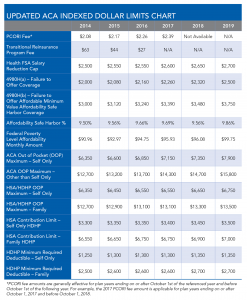
Updated ACA Indexed Dollar Limits Chart

Each year the agencies release Affordable Care Act (ACA) and related indexed dollar limits. The below table is a current summary of these amounts for your reference. We have updated the chart (last published May 15, 2018) to reflect the recently released final figures.

Note that this chart is for illustrative purposes only, and in some cases the effective date of a limit may not be January 1 of the referenced year, but rather may depend on the applicable “plan year”.

Please contact your Conner Strong & Buckelew account representative toll free at 1-877-861-3220 with any questions. For a complete list of Legislative Updates issued by Conner Strong & Buckelew, visit our online Resource Center.

Medicare Part D Notices Due Before October 15

Group health plan sponsors that provide prescription drug coverage to Medicare Part D eligible individuals must notify these individuals whether such coverage is creditable or non-creditable. Creditable coverage means that the coverage is expected to pay on average as much as the standard Medicare prescription drug coverage. For these purposes, group health plans include health plans as defined under ERISA, including certain account-based medical plans, as well as group health plans sponsored for employees or retirees by unions, churches, and federal, state or local governments. The notice requirement applies to insured and self-funded plans, regardless of plan size, employer size or grandfathered status.

Notice must be provided to Medicare eligible active working individuals and their dependents, Medicare eligible COBRA individuals and their dependents, Medicare eligible disabled individuals covered under a prescription drug plan and any retirees and their dependents. The Medicare Part D annual enrollment period runs from October 15 to December 7.  The notice must be provided annually, before the enrollment period begins (i.e., by October 14), and at various other times as required under the law, including to a Medicare eligible individual when he/she joins the plan. Model Part D Notices are available from the Centers for Medicare & Medicaid Services (CMS). A late enrollment penalty is imposed on individuals who do not maintain creditable coverage for a period of 63 days or longer following their initial enrollment period for the Medicare prescription drug benefit. Accordingly, this Medicare Part D notice information is essential to an individual’s decision whether to enroll in a Medicare Part D prescription drug plan. See our Update for more information on this important Medicare Part D notice requirement.

A related disclosure rule requires that sponsors complete the Online Disclosure to CMS Form to report the creditable coverage status of their prescription drug plan. This online disclosure should be completed annually no later than 60 days from the beginning of a plan year (contract year, renewal year), within 30 days after termination of a prescription drug plan, or within 30 days after any change in creditable coverage status. See our Update for more information on this requirement.

For a list of entities subject to the Medicare D disclosure requirement, see CMS’ Entities Required To Provide Disclosure To All Medicare Eligible Individuals. All size employers offering prescription drug benefits are subject to these rules as there is no exception for small employers. See the CMS Creditable Coverage web page for general Part D notice guidance for employer and union-sponsored plans.

Should you have questions about this or any aspect of group health plan requirements, contact your Conner Strong & Buckelew account representative toll free at 1-877-861-3220. For a complete list of Legislative Updates issued by Conner Strong & Buckelew, visit our online Resource Center.