By Jill Ambrose, MBA, BSN, RN and Jackie Becker
Women make up nearly half (47%) of the U.S. workforce and spend an estimated $15 billion more each year in out of pocket healthcare costs than their male colleagues. Employers looking to attract and retain top talent will need to better address women’s health needs through their benefits. Doing so starts with understanding the healthcare disparities women face, what health issues are driving up healthcare costs for women and the support they are looking for from their employers.
It’s well known to those within the healthcare industry that women’s health research lags far behind that of men. In fact, the Food and Drug Administration (FDA) and National Institutes of Health (NIH) did not require the inclusion of women in medical research and clinical trials until 1993. In recent years, women still accounted for less than half of clinical trial participants. Even today, we know so little about women’s health.
According to the NIH, only 6% ($3.1 billion) of its roughly $48 billion budget in 2024 went to women’s health research. Because we don’t understand women’s health, women are more likely to have negative experiences in the health system than men. In research conducted in 2022, 29% of women ages 18-64 who had seen a care provider in the past two years reported that their doctor dismissed their concerns. The inherit gender bias in the healthcare system keeps many women from seeking the care they need, leading to delayed diagnoses, which often cause diseases to be more complex, harder to treat and more costly for both the employer and employee.
While employers have started to view women’s health differently from the rest of their benefits, there are still gaps in the main areas where women need more support. In the last decade, much of the focus on women’s health has been on fertility benefits. However, when looking at the lifetime continuum of care for women employees, maternity care is only a small fraction of their overall health journey. That’s a significant gap considering that approximately one in five workers is a woman aged 45 or older, according to U.S. Bureau of Labor Statistics data from November 2025. Women employees are working through multiple life stages and need to be supported throughout all of them. Here are some of the trending women’s health areas that employers should be aware of and give greater consideration when designing benefits.
One of the biggest trends happening in women’s health is the shift in the age range of women giving birth. According to data from the CDC, from 1990 to 2023 the fertility rate increased 71% for women ages 35-39 and 127% for women ages 40-44. It’s known that pregnancy-associated risks increase for women over 30. At the same time, infertility impacts one in six people globally. Between fertility care and later childcare, growing a family can bring an additional cost burden to many employees.
Employers need to think beyond paid parental leave and consider addressing a broader spectrum of reproductive issues — such as fertility, surrogacy coverage, mental health care, flexible work arrangements, pregnancy loss leave, lactation needs, access for all genders/identities and more — to ensure benefits address financial, emotional and logistical challenges.
There are significant disparities when it comes to cancer incidence and death between men and women. Right now we’re seeing incidence rates for women continue to rise while they decline for men. For women under age 50 the incidence rate is 82% higher than that of men in the same age range. Black women continue to have the highest mortality rate for breast and uterine cancer, both of which are survivable when detected early. In fact, many of the cancers that most often affect women, such as breast, colorectal and cervical cancer, can be survived when detected in the earliest stages.
Often, time and money are the main barriers preventing women from regular screenings. As cancer diagnoses rise in younger women, employers need to consider different approaches to make screenings and detection more accessible – including multi-cancer early detection offerings, offering specific time off for cancer screening or covering the cost of the diagnostic testing if needed after screening. Additionally, employers should consider removing age limits for specific screenings (e.g. colorectal and breast) and for heightened risk profiles (e.g. BRCA gene).
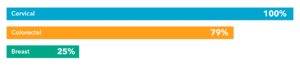
Source: American Association for Cancer Research, Cancer Progress Report 2025
Menopause is a condition that all women experience, and with women remaining in the workforce later in life, many will experience it while working. Recent surveys find that one in five women consider leaving the workforce due to their symptoms. Menopause is estimated to cost U.S. employers $26.6 billion annually in lost work time and medical expenses. Menopause symptoms greatly impact absenteeism and productivity. This is compounded by the fact that women have a hard time finding the resources they need and their symptoms go untreated. Only 35% of women ages 40-64 said that a health care provider discussed what to expect during menopause with them.
Employers should consider women’s-health-specific vendor solutions that provide support and management of perimenopause and menopause symptoms.
About four out of five people with an autoimmune disease are women. This is an emerging area that is impacting a growing number of women in the workforce. With an autoimmune disorder, the immune system attacks healthy tissue, damaging or destroying it. Getting an autoimmune disease diagnosis can be a long and arduous process, taking an average of four to five years from the onset of symptoms. Employees often face costs from seeing multiple specialists, repeated lab work and lost time during periods of undiagnosed flares. From rheumatoid arthritis to multiple sclerosis, most autoimmune diseases are chronic with no cure, so treatments are aimed at managing symptoms.
While science is improving the treatment of these conditions, the treatments are often costly. According to a study by the Integrated Benefit Institute, excess medical and pharmacy costs for employees with autoimmune diseases range from $2,200 to $33,500 annually. As science continues to progress, other advancements such as precision therapies could be initiated for disease management. Employers could consider enhanced flexibility and support for working arrangements to manage disease flare ups and appointments.
There isn’t a perfect or one-size-fits-all answer to addressing the totality of women’s health through employee benefits. But employers need to be more aware of the disparities impacting women’s health and consider women’s health issues in their plan designs. Now more than ever, women’s health benefits are becoming a strategic retention and growth tool. When women have benefits that address their entire continuum of care, they are more productive, feel valued and are more likely to remain with their employer.
Some ways employers can start investing in women’s health benefits include:
Another strategy employers might consider is moving to a self-funded plan. Self-funded plans create an opportunity to bring greater clinical sophistication to benefit strategy. By analyzing claims data at a population level, brokers and consultants can work with employers to anticipate emerging risks, enhance preventative care programs and introduce evidence-based solutions. This approach ensures decisions are driven by data, while reinforcing that employee privacy is not just protected – it is foundational.
Valuing female employees by striving to help them achieve health equity can support organizational growth. Our consultants, in-house population health experts and communication team have helped clients design and implement robust, data driven employee benefits plans that leverage data warehouses and utilize a benefits risk management approach to address the key health issues impacting women today.
Contact a member of our team today to learn how we can help you improve outcomes for your entire employee population.


Jill Ambrose, MBA, BSN, RN
Partner, Head of Population Health

Jackie Becker
Business Development Executive